
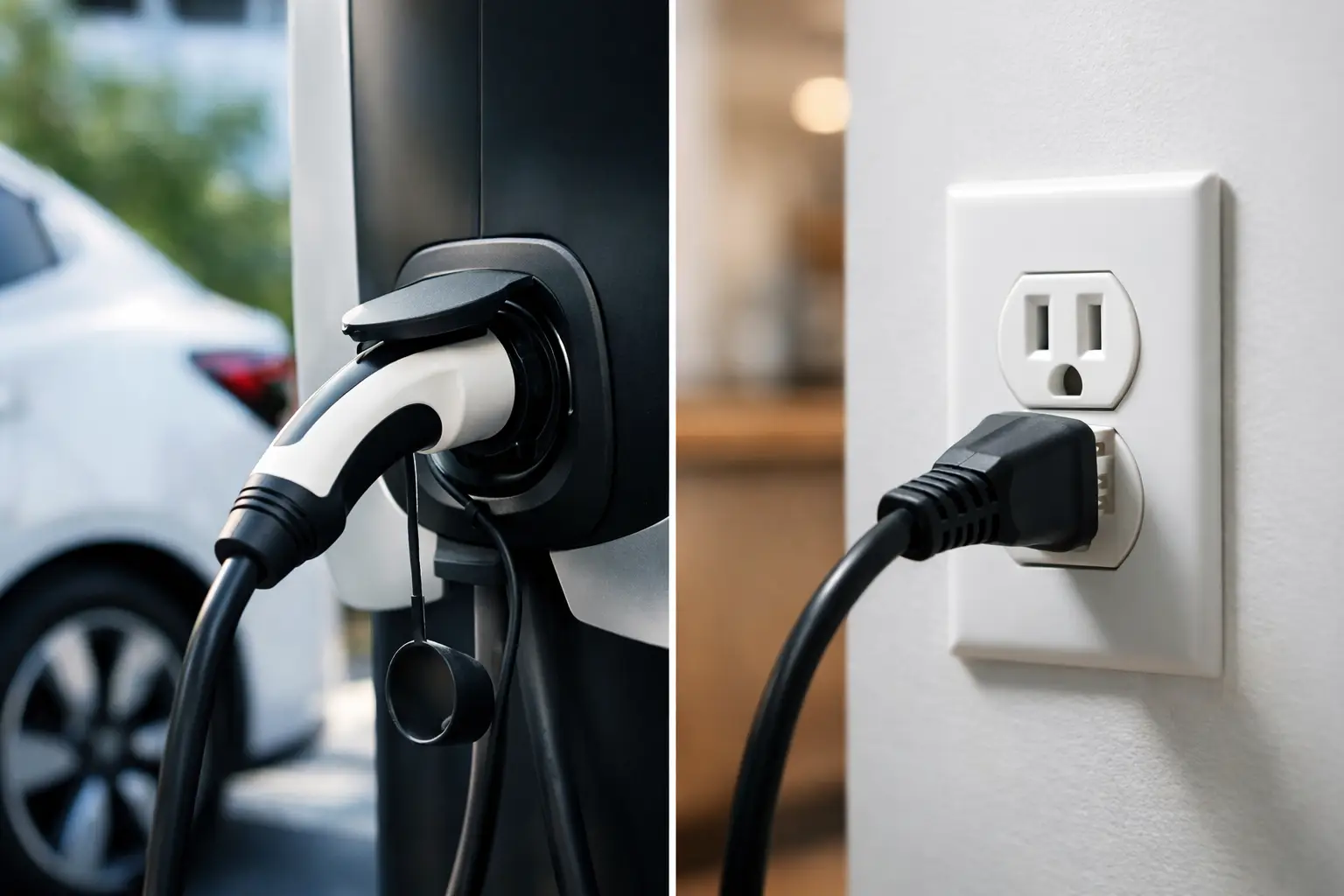
EV Charger vs Standard Outlet: Which Wins?
You plug in your phone every night without thinking twice, so it is reasonable to wonder whether charging an electric vehicle can be just as simple. When homeowners compare an EV charger vs standard outlet, the real question is not just whether both can charge a vehicle. It is whether they can do it fast enough, safely enough, and in a way that fits how you actually use your car.
For some drivers, a standard outlet is enough. For others, it becomes frustrating within the first week. The right choice depends on your daily mileage, your home’s electrical system, and whether you want a short-term workaround or a long-term charging setup.
EV charger vs standard outlet: the basic difference
A standard household outlet usually means a 120-volt receptacle, the same kind used for lamps, TVs, and kitchen appliances. EV charging on a 120-volt outlet is often called Level 1 charging. It works, but it is the slowest option.
A dedicated home EV charger usually means a 240-volt circuit, often referred to as Level 2 charging. This setup delivers significantly more power, which means much faster charging times. It also requires proper electrical planning, the right circuit size, and professional installation.
Both options can charge an EV. That part is simple. The difference shows up in how long it takes and how dependable the setup feels day after day.
Charging speed changes everything
The biggest reason homeowners move from a standard outlet to a dedicated EV charger is speed. A 120-volt outlet may add only a few miles of range per hour. Depending on the vehicle, battery size, and charging conditions, that can mean an overnight charge still leaves you short if you drove a lot the day before.
A 240-volt charger can add range much faster, often enough to fully recharge many daily-driven vehicles overnight. If you commute regularly, make frequent trips, manage a rental property, or simply do not want to think about whether the car will be ready in the morning, that extra charging power matters.
This is where lifestyle matters more than theory. If you drive very little and your EV sits parked for long stretches, a standard outlet may keep up. If you drive every day, the math usually starts favoring a dedicated charger pretty quickly.
When a standard outlet can make sense
There are situations where a standard outlet is perfectly reasonable. If you recently bought an EV and want to start charging at home right away, using an existing outlet can be a practical temporary solution. It can also work for households with plug-in hybrids, since those batteries are smaller and require less charging time.
A standard outlet may also be enough if your driving habits are light and predictable. Someone who drives short local trips and parks at home every night may find that Level 1 charging covers daily needs.
The key issue is patience and consistency. Standard outlets do not give you much recovery time. If you come home low on charge after a busy day, you may need much longer than one night to get back to full. That is where many drivers start looking for something better.
Why many homeowners choose a dedicated EV charger
A dedicated EV charger gives you control. Instead of planning around slow charging, you can charge more efficiently and keep your vehicle ready with less effort.
That convenience is only part of the value. A properly installed Level 2 charger is usually better matched to the electrical demand of charging an EV on a routine basis. Electric vehicles draw power for hours at a time. That is different from many household devices, and it deserves a setup designed for the job.
For homeowners in coastal Alabama, this often becomes part of a larger conversation about service capacity, panel condition, and future power needs. If you are already considering a generator, surge protection, or other electrical upgrades, it often makes sense to look at EV charging as part of the same plan rather than as a separate add-on.
Safety is not the place to guess
This is where the EV charger vs standard outlet decision gets more serious. Yes, a standard outlet can charge an EV. But not every outlet is in good condition, not every circuit is suited for sustained demand, and not every garage or parking area has wiring that should be trusted without inspection.
Older outlets can wear out. Loose connections can generate heat. Shared circuits can create problems if other devices are pulling power at the same time. Extension cords are especially risky and should not be used for routine EV charging.
A dedicated EV charger, installed on the proper circuit, reduces many of those concerns because the equipment and wiring are selected specifically for that load. The installation can also account for code requirements, weather exposure if the charger is outdoors, and the condition of the electrical panel serving the property.
That matters for single-family homes, but it also matters for condos, vacation properties, and commercial spaces where charging access may affect multiple users and multiple liability concerns.
Your electrical panel may decide for you
Some homes are ready for a Level 2 charger with minimal changes. Others are not. The age of the home, the size of the electrical service, and the current load on the panel all play a role.
If the panel is full, undersized, or already supporting high-demand equipment like HVAC systems, water heaters, or pool equipment, an EV charger installation may require upgrades before it can be done safely. That does not mean it is a bad investment. It just means the project needs to be evaluated correctly from the start.
This is one reason online advice can be misleading. Two homeowners can own the same EV and need completely different charging solutions because their homes are wired differently. A professional assessment helps you avoid spending money on the wrong equipment or discovering too late that your panel cannot support what you bought.
Cost is more than the price of the charger
At first glance, a standard outlet seems like the cheaper option because it may already exist. In some cases, that is true. If your driving needs are light, using a 120-volt outlet may delay the need for a larger investment.
But cost should be measured against daily convenience and long-term use. If slow charging creates range anxiety, forces you to rely on public chargers, or leaves you constantly planning around battery levels, the lower upfront cost can become less attractive.
A dedicated EV charger costs more because it usually involves new wiring, a dedicated circuit, and installation labor. Some homes may also need a panel upgrade. Even so, many homeowners see the value in faster charging, better safety, and a setup that supports the way they actually live.
For larger electrical improvements, financing can also make a difference when homeowners want the right solution without delaying the project.
What works best for condos, rentals, and commercial properties
The decision gets more complex when the property is not a simple single-home setup. Condo owners may have shared electrical infrastructure, HOA requirements, or assigned parking issues. Property managers may need to think about tenant access, metering, and future demand. Business owners may want charging available for employees, customers, or fleet vehicles.
In those situations, a standard outlet is usually not the best long-term answer. It may seem simpler at first, but it rarely provides the speed, durability, or user experience that multi-user properties need. A properly designed EV charging installation is usually the better path because it can be planned around actual usage, electrical capacity, and code requirements.
That is especially true in areas where properties serve seasonal residents or guests. People expect charging to be easy. If it is part of the property offering, it needs to work reliably.
So which one should you choose?
If you drive short distances, own a plug-in hybrid, or need a temporary starting point, a standard outlet may be enough for now. It can work well when your charging needs are modest and your existing outlet and circuit are in good condition.
If you drive daily, want faster overnight charging, or are planning to keep your EV for the long term, a dedicated charger is usually the better investment. It offers better performance, a more dependable setup, and fewer compromises.
The smart move is not choosing based on guesswork. It is choosing based on how much you drive, what your electrical system can handle, and whether your property is set up for safe, reliable charging. For homeowners and property owners in Gulf Shores and nearby communities, that often starts with having a qualified electrician look at the panel, the parking location, and the charger you plan to use.
A charging setup should make owning an EV easier, not add another daily hassle. If your current plan feels slow, uncertain, or pieced together, that is usually a sign it is time to look at a better one.