
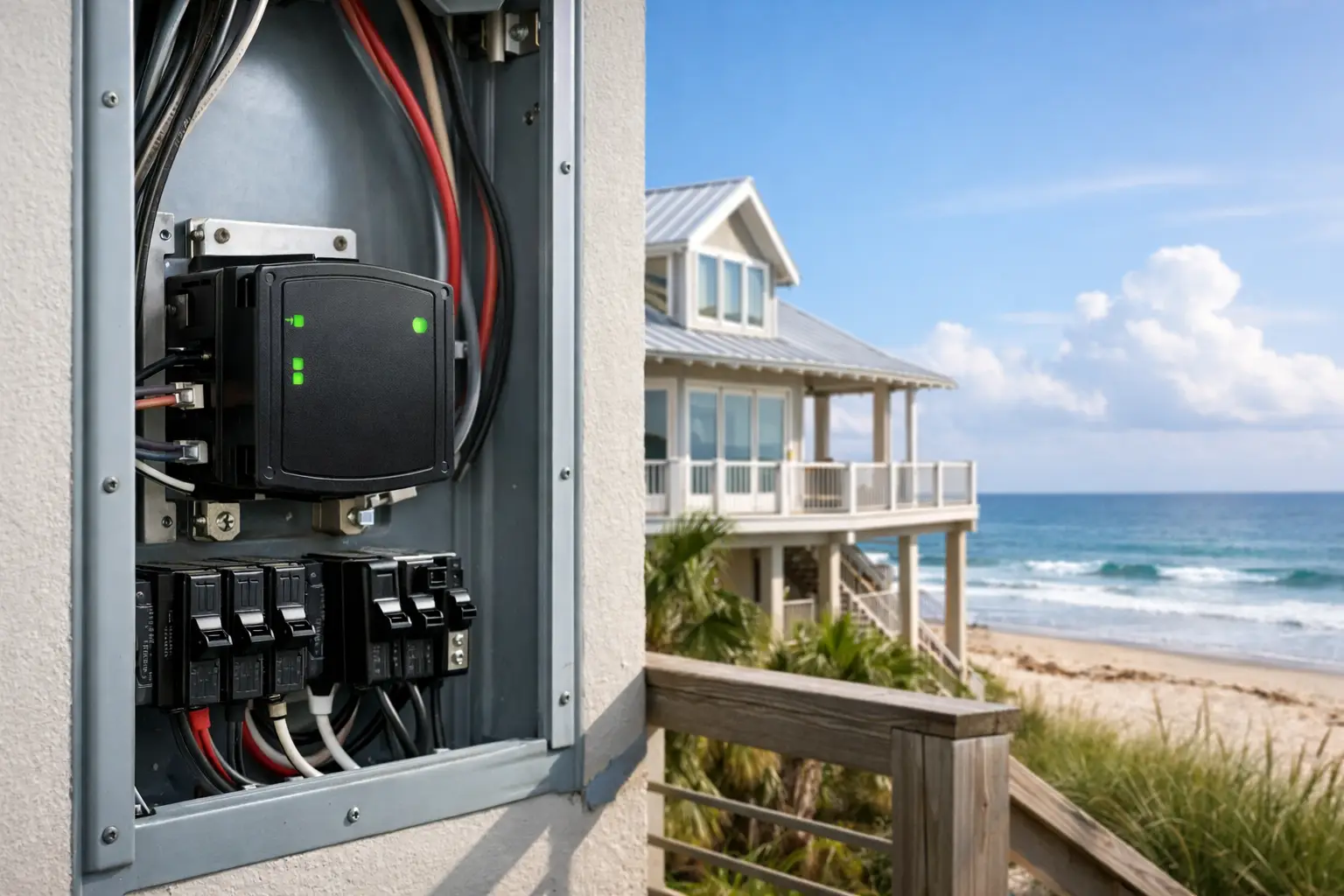
Best Whole Home Surge Protectors for Coastal Homes
A single power surge can do more than ruin a television. It can damage HVAC controls, refrigerators, garage door openers, smart home equipment, appliances, and the electronics built into modern electrical systems. The best whole home surge protectors provide a first line of defense at the electrical panel, where they can help reduce the impact of voltage spikes before those spikes move through the property.
For homeowners and property managers along the Alabama coast, surge protection deserves extra attention. Summer thunderstorms, utility interruptions, generator transfers, and the demands of high-value equipment all create reasons to protect the electrical system as a whole. The right device is not simply the one with the largest number on the package. It must be properly rated for the building and installed correctly at the service equipment.
What a Whole-Home Surge Protector Does
A whole-home surge protective device, often called an SPD, connects at or near the main electrical panel. When an abnormal voltage spike enters the system, the device is designed to redirect excess energy safely away from branch circuits and connected equipment.
Surges are not always caused by a nearby lightning strike. Utility switching, downed lines, transformer issues, large motors cycling on and off, and power returning after an outage can all create harmful fluctuations. Smaller surges can happen repeatedly over time, gradually wearing down sensitive circuit boards and electronic controls.
Whole-home protection is different from a plug-in power strip. A quality plug-in protector can still be useful for computers, entertainment systems, and other sensitive electronics. But it only protects the devices plugged into it. A panel-mounted SPD helps protect hardwired equipment and appliances throughout the building, including equipment that cannot reasonably connect to a power strip.
No surge protector can guarantee protection from every electrical event, especially a direct lightning strike. Proper grounding, bonding, and a sound electrical system remain essential. Still, a properly selected whole-home device is a practical upgrade that can reduce risk across the property.
Best Whole Home Surge Protectors: What to Compare
The best choice depends on the electrical service, the type of property, the equipment being protected, and the condition of the existing panel. Instead of choosing by price alone, compare the specifications that indicate whether a device is appropriate for the installation.
Start with the SPD Type
For most homes, a Type 2 surge protective device installed at the main service panel is the common solution. Type 2 devices are installed on the load side of the service disconnect and protect the electrical system from surges originating outside or inside the home.
A Type 1 device can be installed on the line side of the service disconnect or at the service equipment, depending on the product and application. These are often considered when protection is needed at the service entrance. The right type depends on the panel layout, local code requirements, and manufacturer instructions.
An electrician should assess the installation rather than assuming every panel accepts every device. Some surge protectors mount externally beside the panel, while others are designed to fit inside specific panel brands and models.
Look at the Ratings That Matter
Surge protection specifications can be confusing, but several ratings deserve close attention. A higher surge current capacity, measured in kiloamps or kA, generally means the device can handle more surge energy over its service life. For many residential applications, a quality device rated around 40 kA to 80 kA per phase is a reasonable range to discuss with an electrician, although larger homes or commercial properties may call for more capacity.
The nominal discharge current rating, shown as In, indicates how the device performs under repeated standardized surge testing. Higher values can be beneficial, particularly in locations with frequent electrical disturbances.
Also review the voltage protection rating, or VPR. In simple terms, this indicates the level of voltage the device allows through during testing. Lower is generally better, as long as the unit is properly listed and suitable for the electrical system.
A device should also carry a current UL 1449 listing. This is a key safety standard for surge protective devices. For panel installations, the short-circuit current rating, or SCCR, must be compatible with the available fault current at the electrical equipment. This is not a rating to guess at.
Choose a Device With Clear Status Indication
Surge protectors do not last forever. Each significant surge can reduce the capacity of the protective components inside the device. A model with visible LED status lights, an audible alarm, or remote monitoring makes it easier to know whether the unit is still functioning.
This matters for rental properties, condos, and commercial spaces where an owner may not see the electrical panel regularly. If a status light indicates the protector has reached the end of its service life, it should be evaluated and replaced promptly.
Match the Protector to the Panel and Electrical Service
The best whole home surge protectors must match the voltage and configuration of the electrical system. Most modern residences have 120/240-volt single-phase service, but the panel brand, available breaker spaces, wiring condition, and service age all affect the installation.
An older panel may need repairs, updated labeling, or a service upgrade before it is the right candidate for a surge protective device. If a home has a generator, solar equipment, an EV charger, pool equipment, or multiple HVAC systems, those details should be part of the planning conversation. These systems can benefit from coordinated protection, but they also require proper design.
Why Coastal Properties Need a Layered Approach
Gulf Coast properties face more than a typical electrical load. Frequent thunderstorms can increase exposure to lightning-related surges, while outages and restoration events may place stress on sensitive equipment. Condos and vacation homes may also sit unoccupied for long periods, leaving damage undiscovered until an owner arrives or a guest reports a problem.
A panel-mounted SPD is the foundation, but layered protection offers stronger coverage for valuable electronics. This may include point-of-use surge protection at televisions, network equipment, and office electronics. Some HVAC systems, pool controls, and outdoor equipment may also warrant equipment-specific protection where appropriate.
Grounding and bonding are equally important. Surge energy needs a low-impedance path to ground. Loose connections, corroded components, improper bonding, or aging electrical equipment can limit the effectiveness of the surge protection system. Coastal humidity and salt air make regular electrical inspections especially worthwhile for exterior equipment and service components.
Installation Quality Matters as Much as the Device
Even an excellent surge protector can perform poorly when it is installed incorrectly. Lead length, conductor routing, breaker selection, panel capacity, and grounding connections all influence performance. In general, the connection between the SPD and panel should be as short and direct as practical, following the manufacturer’s instructions and applicable electrical code.
This is not a typical do-it-yourself upgrade. Work inside a main panel involves energized components and significant shock and arc-flash hazards. It also requires an understanding of panel compatibility, overcurrent protection requirements, and safe workmanship.
A qualified electrician can inspect the existing service, identify whether the panel is suitable, recommend an appropriately rated device, and verify the grounding and bonding system. For a larger project, such as a service upgrade, generator installation, or EV charger installation, surge protection is often most cost-effective when planned as part of the overall electrical work.
When It May Be Time to Replace or Add Protection
Consider a whole-home surge protector if your property has no panel-level protection, if you recently added expensive electrical equipment, or if your area has experienced repeated outages or storms. It is also a sensible addition after an electrical panel replacement or service upgrade.
If an existing SPD shows a warning light, lacks a normal status indicator, has visible damage, or is old enough that its condition is uncertain, schedule an evaluation. A protector that has sacrificed itself during a surge may leave the home unprotected without an obvious appliance failure.
For homeowners and property managers in Gulf Shores, Orange Beach, and nearby Baldwin County communities, MNE Electric can evaluate the electrical panel and recommend a properly rated surge protection solution. The goal is straightforward: protect the systems your property depends on before the next outage, storm, or unexpected voltage event tests them.