
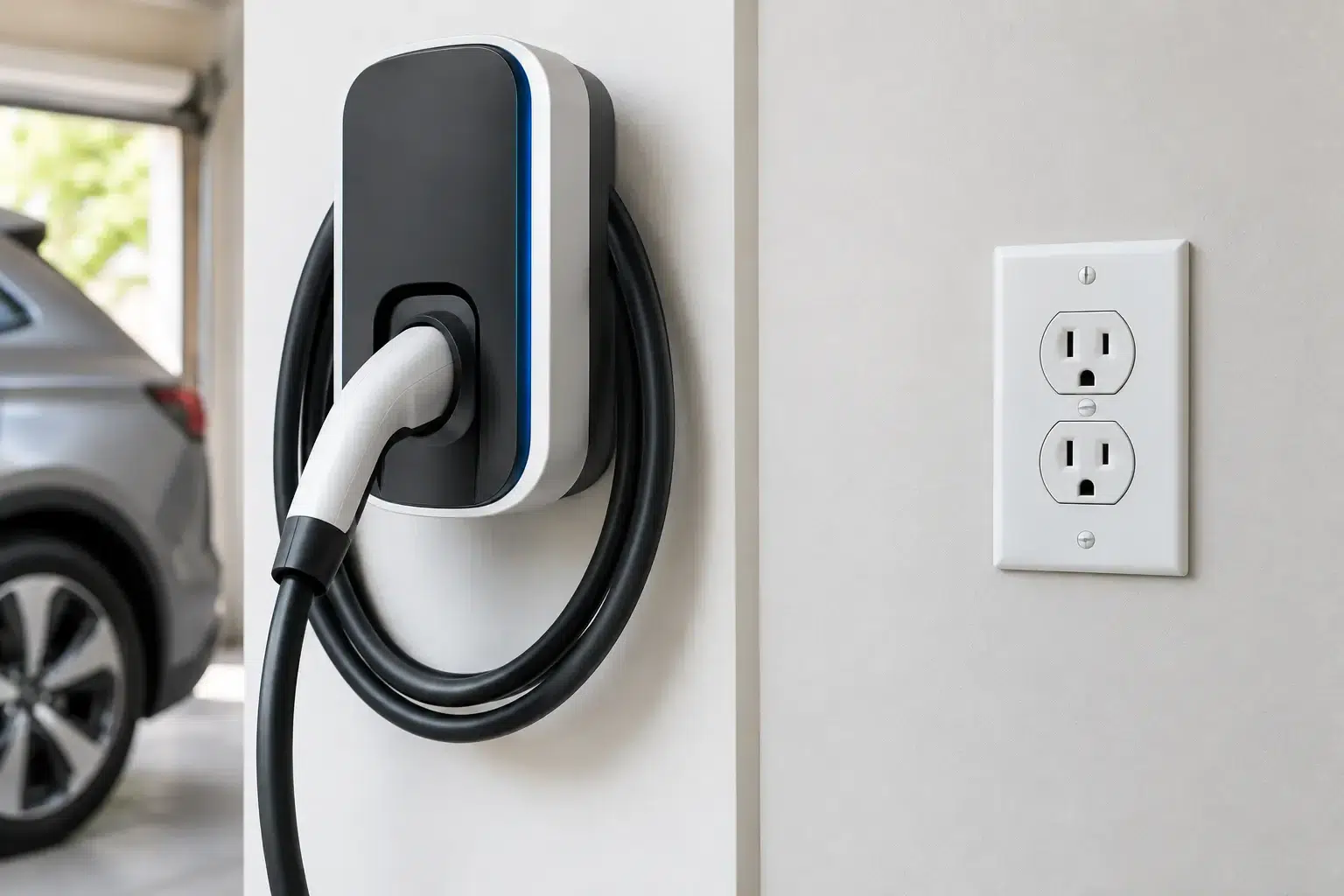
EVSE Versus Standard Outlet: Which Is Safer?
A new EV often arrives with a plug-in charging cord, and the obvious question is whether the garage outlet is enough. The EVSE versus standard outlet decision is not simply about convenience. It affects charging time, electrical safety, and whether your home’s wiring is prepared for a load that may run for hours at a time.
For some Gulf Shores and Orange Beach homeowners, a standard 120-volt outlet is a workable starting point. For others, especially drivers with longer commutes, larger batteries, or more than one electric vehicle, a professionally installed Level 2 EVSE is the practical answer. The right choice depends on how you drive, where you park, and the condition and capacity of your electrical system.
EVSE Versus Standard Outlet: Understand the Difference
An outlet is the receptacle in the wall. An EVSE, short for electric vehicle supply equipment, is the equipment that safely delivers power from the electrical system to the vehicle. It communicates with the vehicle, confirms that the connection is safe, and controls when power can flow.
That distinction matters because the portable cord that comes with many EVs is itself an EVSE. When it plugs into an ordinary household outlet, it is usually providing Level 1 charging. A wall-mounted charger connected to a 240-volt circuit is also an EVSE, typically providing Level 2 charging.
So the real comparison is usually between Level 1 charging through a standard 120-volt outlet and a dedicated Level 2 EVSE on a 240-volt circuit. Both can charge an EV safely when the equipment and wiring are properly matched. They serve very different daily needs.
What a Standard Outlet Can Do
A standard household outlet normally provides 120 volts. With the portable EVSE supplied by the manufacturer, many vehicles charge at roughly 1.2 to 1.4 kilowatts. In practical terms, that often adds about 3 to 5 miles of driving range per hour.
If a vehicle sits in the garage overnight and daily driving is modest, that may be enough. A driver who travels 25 or 30 miles a day can often recover that energy while sleeping. Level 1 charging also avoids the upfront cost of installing new charging equipment.
The limitation is time. Recharging a mostly depleted battery through a standard outlet can take well over a day, and sometimes several days for a larger battery. If you return home with a low battery on Friday and need the vehicle ready for a longer weekend trip, a 120-volt outlet may not keep up.
There is also an electrical condition to consider. Charging is a continuous load, meaning it can run for three hours or more. Older outlets, loose connections, worn receptacles, extension cords, and circuits shared with garage refrigerators, freezers, or tools are not good candidates for regular EV charging. Heat at the plug, a loose-fitting cord, or a breaker that trips are warning signs that deserve prompt attention.
Why a Level 2 EVSE Is Different
A Level 2 EVSE uses a dedicated 240-volt circuit, similar in concept to the circuit used for certain large appliances. Depending on the vehicle, EVSE rating, and available electrical capacity, it can add roughly 15 to 40 or more miles of range per hour. Most drivers can fully replenish their normal daily use overnight.
That speed changes how the vehicle fits into household routines. You can come home with a low charge, plug in after dinner, and have meaningful range available by morning. It is also more practical for households with two EVs, frequent travel, rental properties, and businesses that want to offer employee or customer charging.
A permanently mounted EVSE can be easier to use than unpacking and reconnecting a portable cord each day. Many units offer scheduling, energy-use monitoring, and controlled access. Those features are helpful, but charging speed and a correct installation matter more than extra app features.
Level 2 installation does require planning. The electrical panel must have adequate capacity, the circuit must be sized for the selected equipment, and the wiring route must be safe and code-conscious. In some homes, the charger installation is straightforward. In others, a panel upgrade, load calculation, or longer wiring run is needed before adding the circuit.
Safety Is About the Entire Charging Setup
It is tempting to judge the EVSE versus standard outlet choice by charging speed alone. Safety should carry equal weight. An EV can draw substantial power for many consecutive hours, so the circuit, receptacle or hardwired connection, breaker, wiring, and charging equipment all need to work together.
A dedicated circuit is generally the preferred arrangement for regular EV charging. It reduces the chance that other equipment will overload the circuit while the vehicle is plugged in. Electrical codes also apply specific requirements to EV charging installations, and those requirements can vary based on the equipment type and location.
Never rely on an extension cord as a permanent charging solution. Even a heavy-looking extension cord may not be rated or installed for continuous EV charging. Avoid adapters unless they are approved by the vehicle and equipment manufacturers for the exact use. A cheap adapter or an outlet that no longer grips the plug firmly can create resistance and heat where you least want it.
For coastal Alabama properties, location deserves extra attention. Garages, carports, outdoor parking areas, and elevated beach homes can expose equipment to humidity, wind-driven rain, salt air, and physical damage. An appropriately rated enclosure, correct mounting location, and protected wiring help the installation hold up over time.
Hardwired EVSE or Plug-In EVSE?
Both options can be appropriate. A plug-in Level 2 EVSE uses a dedicated 240-volt receptacle. It can be convenient if you may take the unit with you or replace it later without electrical work. The receptacle, however, must be correctly rated for the charging load and installed to handle regular use.
A hardwired EVSE connects directly to the circuit. It eliminates one plug-and-receptacle connection and is often a clean choice for a permanent home installation. It may also allow higher charging output, depending on the equipment and electrical design. The better option depends on your charger, your future plans, and the condition of the installation area.
How to Decide What Fits Your Home
Start with your normal driving, not the maximum range printed on the vehicle window sticker. If you drive short distances, have reliable overnight parking, and can charge every night, a standard outlet may cover your needs. It is still worth having the outlet and circuit inspected if you plan to use it regularly.
A Level 2 EVSE is usually worth considering when you drive more than about 40 miles most days, need faster recovery between trips, own a larger-battery vehicle, or want the flexibility to charge two vehicles. It is also a strong choice when you want to avoid planning your schedule around charging time.
Before purchasing equipment, confirm the vehicle’s onboard charging capability. The EVSE cannot make the car accept more power than it is designed to take. Then consider the distance from the electrical panel to the parking space, available panel capacity, whether the charger will be indoors or outdoors, and whether future EV ownership is likely.
For condos, vacation properties, and commercial sites, the decision may involve more than one parking space. Electrical capacity, metering, access control, and the ability to expand later should be considered before installing the first charger. Planning for future conduit or panel capacity can prevent costly rework later.
Get the Electrical Work Right From the Start
An EV charger is a long-term electrical load, not just another device to plug in. A qualified electrician can evaluate your panel, calculate the expected load, identify whether upgrades are needed, and install the correct circuit and equipment for your vehicle and parking arrangement.
MNE Electric helps homeowners and property operators in Gulf Shores and nearby coastal communities install EV charging equipment with safety, capacity, and everyday usability in mind. A proper evaluation gives you a charging setup that fits your routine now while leaving room for the way you may drive tomorrow.