
Why GFCI Outlets Trip and What to Do Next
A GFCI outlet that trips every time you plug in a bathroom hair dryer, patio lights, or a garage tool is doing more than interrupting your day. Understanding why GFCI outlets trip can help you separate a normal safety response from a problem that needs professional attention. In either case, repeatedly forcing the outlet to reset is not the answer.
A ground-fault circuit interrupter, commonly called a GFCI, is designed to shut off power quickly when electricity may be escaping its intended path. That protection matters most around water and grounded surfaces, which is why GFCIs are commonly installed in kitchens, bathrooms, laundry rooms, garages, exterior areas, crawl spaces, and pool-related spaces.
What a GFCI Outlet Is Actually Watching For
A standard circuit breaker primarily protects wiring from too much current. A GFCI does something different. It compares the electricity leaving on the hot wire to the electricity returning on the neutral wire. Under normal conditions, those amounts match.
If even a small amount of electricity takes another path – through water, damaged insulation, a metal appliance case, or potentially a person – the GFCI senses the imbalance and disconnects power. It can trip before a conventional breaker sees a large enough load to respond.
That is why a GFCI may trip even when nothing seems obviously wrong. The outlet is responding to a possible leakage path, not simply to how many devices are plugged in.
Why GFCI Outlets Trip: The Most Common Causes
The cause may be a plugged-in appliance, moisture, damaged wiring, or the GFCI device itself. Finding the source requires a methodical approach because one GFCI outlet may protect several other outlets downstream.
A Faulty Appliance or Cord
This is one of the most common reasons. A worn appliance cord, damaged plug, aging heating element, or internal motor problem can allow a small amount of current to leak to ground. Hair dryers, coffee makers, refrigerators, freezers, pressure washers, dehumidifiers, power tools, and outdoor equipment are frequent culprits because they operate near moisture or contain heating and motor components.
If the GFCI resets with everything unplugged but trips when a particular item is connected, stop using that item until it has been repaired or replaced. Do not assume the outlet is bad simply because one appliance causes it to trip.
Moisture Where It Should Not Be
In coastal Alabama, humidity, wind-driven rain, salt air, and wet outdoor conditions can all contribute to electrical issues. Exterior receptacles, garage outlets, patio equipment, pool-area circuits, and outlets near plumbing are especially vulnerable.
Moisture inside an outlet box, cover, plug, appliance, or junction box can create the leakage a GFCI is built to detect. Sometimes the problem appears only after heavy rain or when morning humidity is high. A weather-resistant outlet with a properly installed in-use cover helps, but it cannot correct a damaged box, cracked cover, loose gasket, or water entering through a failed connection.
Never reset or handle an outlet that is visibly wet. If water has entered an electrical box, the equipment should be inspected and dried or replaced as needed by a qualified electrician.
A Wiring Problem on the Circuit
A GFCI can trip because of a loose connection, damaged cable, nicked insulation, an improperly connected neutral, or a problem at another outlet farther down the line. This is more likely when the outlet trips with nothing plugged in, will not reset, or trips unpredictably.
Older homes, remodeled spaces, and outdoor circuits can have hidden wiring issues that are not visible at the receptacle. A loose neutral connection may cause intermittent tripping. A shared neutral or incorrectly wired downstream device can also create nuisance trips or prevent a reset.
This is not a situation to solve by moving wires around inside the box. Electrical troubleshooting requires proper testing equipment and an understanding of how the circuit is configured.
An Aging or Failed GFCI Device
Like other electrical components, GFCI outlets do wear out. Internal parts can weaken over time, particularly in damp, hot, or corrosive environments. A failed GFCI may refuse to reset, trip without a clear cause, or fail its test function.
Replacement is often straightforward for a professional, but the important question is whether the device failed on its own or was reacting to a condition elsewhere on the circuit. Replacing an outlet without checking the circuit may only hide the real problem temporarily.
Too Much on the Circuit – Sometimes
A GFCI is not primarily an overload device, so a high electrical load alone usually trips the circuit breaker rather than the GFCI. Still, a heavily used circuit can expose a weak appliance, a loose connection, or a wiring defect. For example, a bathroom circuit serving several high-wattage grooming appliances may overload the breaker, while one appliance with an internal leakage issue may trip the GFCI.
If both the GFCI and breaker are tripping, or if power demand has increased after adding appliances, refrigeration, outdoor equipment, or EV charging, the circuit should be evaluated rather than repeatedly reset.
A Safe Way to Narrow Down the Problem
Start by unplugging everything connected to the affected outlet and any nearby outlets that may be protected by it. Press the GFCI reset button once. If it stays reset, reconnect devices one at a time and wait briefly between each one. When the GFCI trips again, the most recently connected item is a strong suspect.
If the outlet trips immediately with everything unplugged, leave it off. Check for obvious moisture around exterior outlets or nearby plumbing, but do not remove the outlet cover or attempt internal repairs. The fault may be in the outlet, a downstream receptacle, a light fixture, a junction box, or the wiring in the wall.
It also helps to check whether the affected outlet is the only one without power. A GFCI in a garage, bathroom, utility room, or exterior location may protect outlets in another area of the home. Property managers and condo owners should keep this in mind before assuming multiple outlets have failed at once.
When a Reset Is Reasonable – and When It Is Not
A one-time trip after using a known faulty appliance or after an exterior outlet gets wet can be understandable. Once the appliance is removed or the area is safely addressed, the GFCI may reset normally.
Repeated tripping is different. Call an electrician if the GFCI will not reset, trips with no devices plugged in, feels warm, shows discoloration, makes buzzing sounds, has a burning odor, or loses power after rain. You should also schedule service if a refrigerator, freezer, sump pump, medical device, security system, or other essential equipment is on a circuit that will not stay on.
Do not replace a GFCI with a standard outlet to stop the tripping. That removes a required layer of protection and does not fix the underlying condition. Avoid using extension cords as a permanent workaround, especially in garages, bathrooms, kitchens, or outdoor spaces.
Testing GFCI Protection Matters
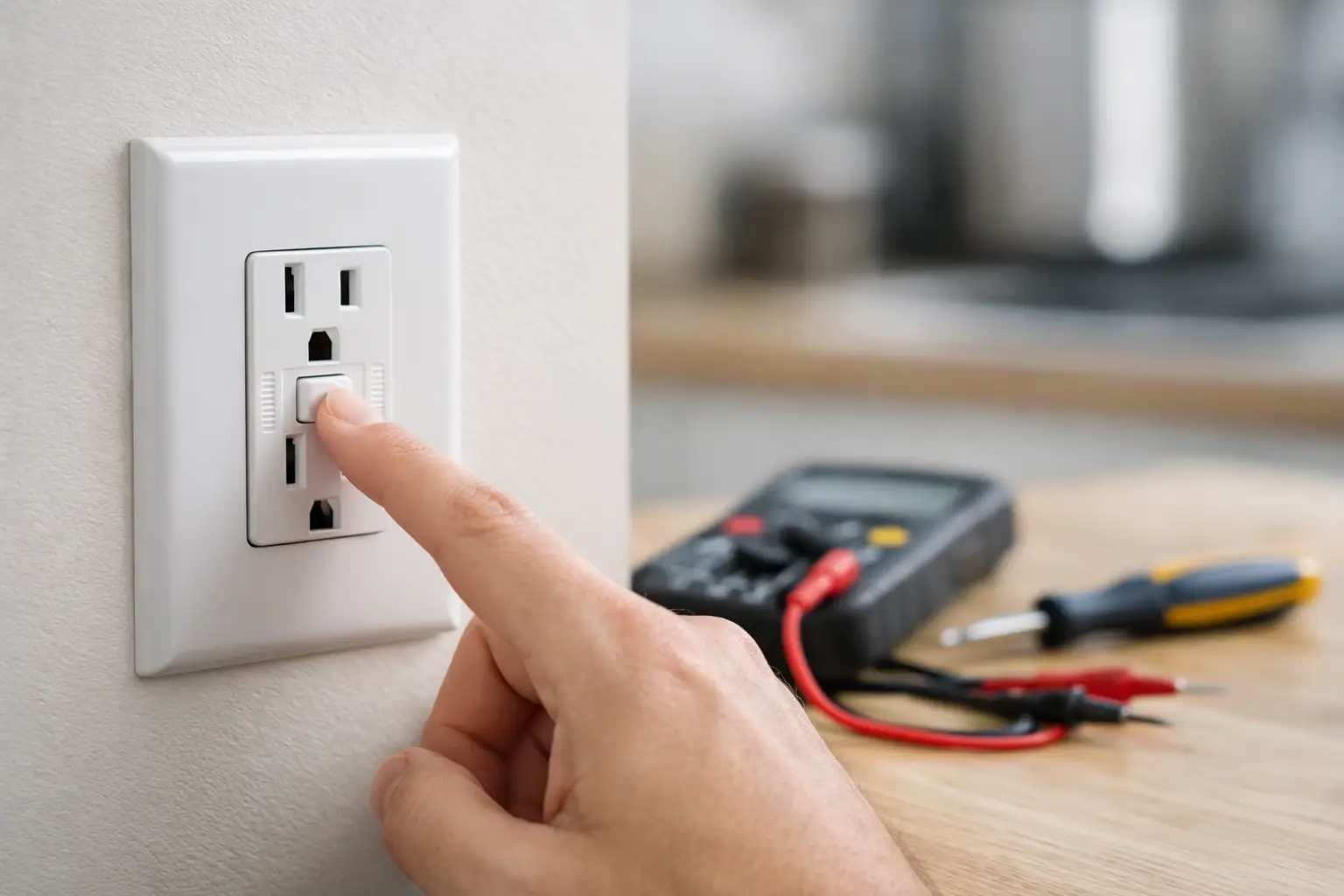
Most GFCI outlets have TEST and RESET buttons. Pressing TEST should shut off power to that outlet and any outlets it protects. Pressing RESET should restore power. Testing periodically is a sensible part of home maintenance, particularly for outdoor and wet-area outlets.
However, a successful button test does not prove every part of the circuit is perfect. It only confirms that the device responded to its built-in test. If an outlet trips repeatedly during normal use, professional diagnosis is still the right next step.
For Gulf Shores, Orange Beach, and nearby coastal properties, exterior electrical equipment deserves extra attention after storms and periods of heavy moisture. MNE Electric can identify whether the issue is a failed device, a damaged appliance, moisture intrusion, or a circuit fault and make the repair correctly.
A GFCI trip can be inconvenient, but it is also useful information. Treat it as a safety signal, not an obstacle to bypass, and address recurring trips before a small electrical issue becomes a larger repair.